Stop 4 of 10
The Donor Area: Healing, Scars and Over-Harvesting
Published Jul 27, 2026Sources re-read Sep 22, 2026
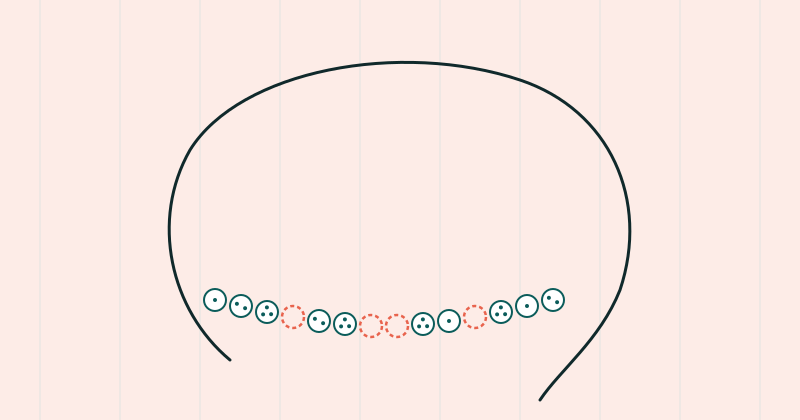
The donor area is the band of hair around the back and sides of your head that supplies every graft in a hair transplant. It usually heals within a couple of weeks, but it keeps a permanent record of the surgery, and if too many grafts are taken it can end up visibly thin, a problem called over-harvesting that cannot be reversed.
Because the donor supply is finite, the donor area is where the long-term consequences of a transplant are decided. This guide covers what it is, how it heals after each technique, what marks it keeps, and how over-harvesting happens. For the procedure as a whole, see our guide to what a hair transplant is and how it's done.
What the donor area is
The International Society of Hair Restoration Surgery (ISHRS) defines the donor area as the fringe above the ears and around the back of the head, where follicles are genetically programmed to remain. In people with pattern hair loss, this zone usually keeps its hair when the front and top thin.
That stability is why donor hair keeps growing after it moves, a principle known as donor dominance. The limit is geographic: the stable zone has edges. Follicles taken from too high up, too low on the neck or too far forward on the sides may be less stable, which matters for how a transplant ages.
Where grafts come from
For most transplants, the donor area is the scalp. In the ISHRS's 2025 practice census, members reported that 91.7% of their FUE donor harvests came from the scalp, 6.1% from the beard and 1.1% from the chest.
Share of members' FUE donor harvests, 2024 data. Source: ISHRS 2025 Practice Census (181 responses). Other sites make up the rest.
Beard and body hair can supplement a limited scalp donor area in selected cases, but they grow differently from scalp hair and are usually a specialist's decision. For most people, the scalp donor band is the whole budget.
How the donor area heals after FUE
After FUE, the donor area is covered in tiny round wounds where units were extracted. The ISHRS says these form small scabs that usually clear in about one to two weeks.
In most cases the donor area is shaved beforehand, so the back of the head looks short and speckled for a while as hair grows back around the extraction sites. Each site heals as a small dot scar. The ISHRS stresses that FUE is not scarless: the scars are small and spread out, and they usually only become noticeable if the hair is cut very short or if too many have been taken from one area.
How the donor area heals after FUT
After strip harvesting, the donor area has a single stitched or stapled wound across the back of the head. The American Society of Plastic Surgeons says stitches come out in a week to 10 days.
The ISHRS describes the strip as 0.5 to 1.5 cm wide and 5 to 30 cm long. Many surgeons use a trichophytic closure, trimming the wound edge so hair can grow through the scar. The result is a linear scar that is usually hidden by hair above it but may show with very short haircuts. A 2025 scoping review in Aesthetic Plastic Surgery listed raised (hypertrophic) or keloid scarring after strip harvesting among reported complications. Numbness around the donor area is also reported and can take time to settle.
What over-harvesting means
Over-harvesting is taking so many grafts from the donor area that the remaining hair looks thin, patchy or "moth-eaten", in the ISHRS's words. The ISHRS ties it to FUE: its FUE page lists over-harvesting among the risks, and its FUT page counts the absence of that danger among strip harvesting's advantages, because a strip takes a defined band rather than units picked until density drops.
The ISHRS lists over-harvesting among FUE's risks and describes it among the problems seen in repair cases. Its Fight the FIGHT campaign against surgery by unlicensed technicians names a depleted donor area among the complications it sees. Unlike most recovery problems, it doesn't heal with time: the extracted follicles are gone.
Why over-harvesting happens
Over-harvesting usually comes from pressure to deliver a large number of grafts in one session. The more grafts sold, the more must be taken, and a donor area only holds so many.
Several things raise the risk:
- a plan built around a graft number rather than the donor area's capacity
- extraction concentrated in one zone rather than spread evenly
- harvesting outside the stable zone to reach the target
- repeated sessions without accounting for what earlier ones took
- surgery performed by people without the training to judge density as they go
The ISHRS's 2025 census gives a sense of how often members see bad work: repairs of earlier black-market transplants averaged 10% of their cases, with a median of 5%. Our guide to hair transplant gone wrong looks at repair in more detail.
Can an over-harvested donor area be fixed?
It can sometimes be improved but not restored. The ISHRS guide to revision work lists scalp micropigmentation, a form of cosmetic tattooing, as one way to make thin areas look denser, and some surgeons use beard or body hair to fill gaps. The ISHRS is direct that not all patients can be helped, and that a lack of donor hair is a reason not to operate.
Prevention is far easier. Ask at your consultation how many grafts will be taken, from where, and how much capacity will remain for any future session. A surgeon who answers with a plan for the donor area, not just a graft count for the front, is thinking about the right thing.
Caring for the donor area after surgery
Your clinic's instructions come first, and they will cover washing, sleeping and activity. General guidance from the American Society of Plastic Surgeons includes gentle washing within two days and avoiding vigorous exercise and contact sports for at least three weeks.
Watch for signs of infection, such as spreading redness, increasing pain, warmth or pus, and call your clinic promptly if they appear. Our guide on how many grafts you need explains how the donor budget fits into planning, and the diagnosis should always come first: a GP or dermatologist can confirm the cause of your hair loss, and it pays us nothing to say so.
Signs your donor area was well handled
Months after surgery, a well-managed donor area is hard to spot with your usual haircut. Extraction sites or the strip scar are hidden, and the density looks even rather than patchy.